EMS Manufacturer Deal Flow: Why Some EMS Manufacturers Grow Faster Than Others


This post focuses on challenges facing EMS provider CEOs and owners of electronics manufacturing services (EMS) businesses when marketing and selling your services to prospective customers. It also contains good knowledge for OEM equipment manufacturers identifying and seeking capable EMS companies.
Issues identified are from years of working in, and with, EMS companies supported by candid discussions with OEM buyers and customers of EMS services. These discussions with OEMs are ongoing and take place at all phases of the OEM-EMS provider engagement and range from:
- OEM feedback about the nature and experience of the EMS provider's RFP / RFQ process
- disclosure (vs. discovery) during OEM's due diligence of EMS provider factory and business capabilities, and
- the quality of EMS provider support post agreement-signing, and general business dialogue...to name a few
One prevailing theme in nearly every OEM discussion is buyers are seeking better ways to gather information about contract electronics services industry and ways to select and manage their EMS partners.
This post is not specific to any one contract electronic industry or market vertical.
EMS growth opportunity, specialization and stickier customer relationships
Ideal capacity utilization for an EMS provider is roughly 75 percent when measured across 24 hours, seven days a week. Depending on the EMS business model and markets served this can cover cost of doing business + profit and it tells OEM prospects your services are in demand and some upside capacity exists should his program volumes fluctuate or spike.
Although Europe is facing increasing challenges and China growth has slowed, compared to growth rates years earlier, periods of economic recovery in some regions and tech market verticals find many electronics OEMs with internal capacity shortages which pushes these OEMs to increase sourcing with EMS manufacturers.
Trends like AI in manufacturing supply chains are profitable for some EMS providers willing to invest in tech because wins are incremental and often without large capex, asset purchases thereby creating opportunity for higher EMS margins.
 Mark Zetter
Regardless of global economic influences and regional business environments EMS CEOs must constantly be on the lookout for ways to differentiate and place their services in front of OEMs.
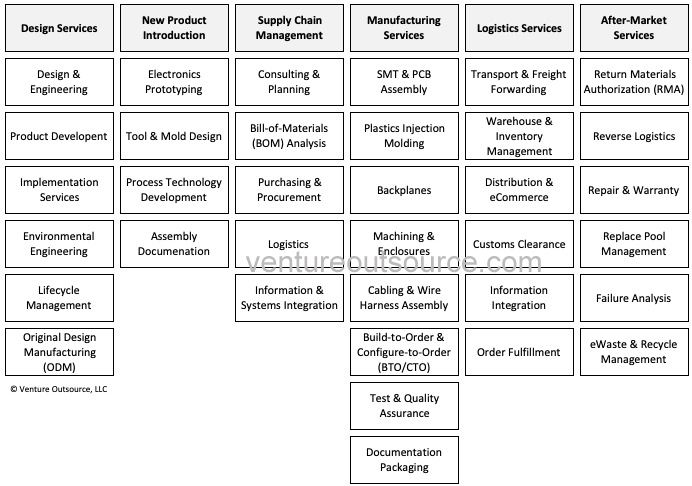
More EMS differentiation exists today, especially among larger EMS providers, regarding EMS provider specialties compared to where most EMS providers were five to ten years ago. Yet, the majority of EMS providers I speak with are unable to unlock their differentiation and communicate it in a distinctive manner.
For an actual industry example, looking at the telecommunications inustry, Provider A focuses on video content communications whereas Provider B, serving the same telecommunications space, focuses his services on 6G, optical and piezoelectronics. Numerous other examples also exist across every other industry end market and market verticals.
Larger, tier-1 EMS providers today are also taking in considerably smaller OEM lot sizes than in the past and all vertically integrated EMS providers (and even some non-vertically integrated and smaller providers) are positioning themselves as solutions partners compared to the role perceived as 'commodity buyers', a badge many EMS manufacturers wore just a couple of decades ago.
Furthermore, the EMS provider return-on-assets (ROA) metric has typically yielded different financial results for providers depending on industry segments - where a provider participates.
According to one Wall St. analyst, “I think the realistic view of what’s able to be accomplished in ROA can ultimately be quite different as a result of the type of industry segment participation and customers [EMS providers] serve. Perhaps more so than the execution.”
Is EMS execution no longer important? Sure it is, and success is the providers to lose so long as EMS providers have proper equipment, adequate technical capabilities, a reasonably good executive management team plus sound processes and procedures in place. But regardless of any preparations EMS providers implement, no plan survives the war.
 Mark Zetter
Success is never guaranteed and EMS sales and marketing activity still remains integral to help drive new business opportunity despite EMS CEOs wanting to create more value-add and stickier existing customer relationships.
Differentiation does not make growth easier for EMS CEOs
Vertically integrated, full service global contract EMS providers, with multiple facilities in key geographies, can attract a wider variety of OEM business opportunities, in a same period, compared to non-vertically integrated EMS providers with fewer facilities. The same can be said when also comparing EMS providers with facility locations concentrated in one region.
However, one downside to full-service EMS providers with factories in key regions is operating margin is more likely to take a hit during slow periods. These downturns can give OEM prospects leverage when negotiating contract pricing. EMS factory capacity utilization can be a leading indicator of opportunity for OEMs.
Either way, size matters in the worldwide market for contract electronics manufacturing. For EMS provider CEOs wanting to grow, you have several options. Growth can be based on a previous relationship with the customer and/or an existing piece of business with that customer.
The deal can also be with a new customer where the EMS sales person had no prior relationship with the customer. For example:
- New sales hire lands business from previous EMS employer (existing relationship)
- Sales person lands business based on previous deal (existing relationship)
- Sales person lands ‘new’ business based on a new relationship
Many EMS CEOs, particularly tier-1s, want to focus on ways to get more business from existing customer relationships. They want to go deeper into customer wallets. Rightly so.
Sticky EMS relationships can drive deeper customer supply chain involvement (read: higher margins) with providers. Costs for additional business from existing customers can almost be negligible when compared to investments of time and money to identify and land ‘new’ EMS business customers.
A major benefit of the latter, EMS CEOs tend to minimize how costs for growing the business are identified - ahead of revenues - due to headcount costs for marketing staff, sales people and manufacturing reps.
In fact, some EMS providers are so focused on stickiness their TAM of OEM prospects consists of no more than 20 target companies which they continually nurture. EMS companies can grow in many ways. Some of these transactions for EMS growth include:
- Operating investments
- Affiliate relationships
- Joint ventures and partnerships
- Mergers and acquistions
- Deal closing (sales)
Barring opportunity for EMS manufacturers in positions for transacting partnerships and acquisitions to enable faster growth, EMS CEOs rely on a team of marketing and sales professionals to grow business.

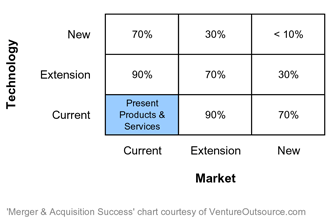
EMS marketing challenges locating new customers
However, finding qualified leads is not easy. But assuming EMS marketers do find leads, qualifying these leads still remains more art than science. Good OEM buyers are critical thinkers with independent thought and emotions also come into play. Other challenges facing EMS CEOs include:
- Difficulty identifying who the decision makers are once prospect companies are identified
- Difficulty timing EMS-OEM decision maker engagement at moment of relevance
- Long sales-to-close cycles
- High acquisition costs: finding suitable EMS sales employees, benefits, reps, legal, systems, tech and software...
A non-scientific review of a few of hundred Linkedin profiles for non-executive EMS industry marketing and sales people employed in EMS companies above US$500 million income reveals these EMS marketers and sales people tend to remain longer, on average (three to five years), with the same EMS employer when compared to EMS marketers and sales persons with similar roles and titles and employed by smaller EMS providers (less than $250 million), where EMS marketers and sales people in smaller firms tend to leave sooner, 12 to 18 months, on average.
Discussing this with EMS CEOs across tiers, some provider questions include: Do larger EMS providers hire more capable sales persons, perhaps indicating success and therefore employed longer history with the company? Does headcount insulation in larger EMS providers delay EMS management from identifying sales non-performers sooner? Are smaller EMS providers attracting only less capable EMS sales people?
The true cost of closing that lead
Its not uncommon for EMS providers with sales between US$500 million and $1 billion to have separate rep agreements with as many as 25 to 50+ manufacturing reps, in addition to full-time sales and marketing staff.
Manufacturing reps bring both hard and hidden costs to the transaction.
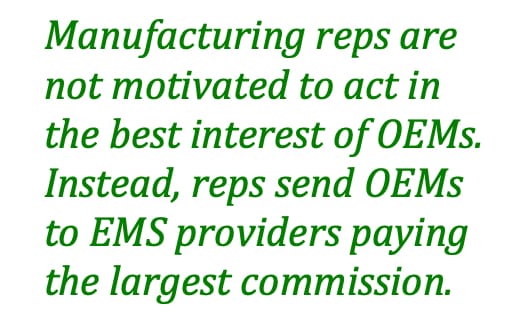
Most manufacturing reps working with EMS providers are on a commission basis, only. Some EMS providers require a rep bring in a minimum amount of business every month, or quarter or year. The commission-only contractual arrangement is flawed from the start because the rep cannot rely on one provider to put food on his table so he’ll rep services from other EMS providers.
This does little to build provider-OEM relationships because the rep will not act in the OEM’s best interests, instead sending OEM prospects to the provider who pays the highest commission.
But while not all EMS providers use manufacturing reps, all EMS providers have sales people and as effective marketing focused on locating customers becomes more challenging, OEM buyers of EMS services have become more informed about contract electronics industry and are making decisions based on more critical thinking which runs counter to ‘big picture’ sales talk.
These new market dynamics used by OEMs are challenging the EMS provider manufacturing rep model and models used by nearly all EMS industry sales people.
Rep, or not, the EMS sales effort no longer can rely on ‘small talk’ with prospects by sales people who hope to build bridges and friendships and still expect to close deals, like years ago.
 Mark Zetter
EMS market and industry research indicates some reps are not only preventing providers from winning the right business, but in the process of grabbing commissions, at all costs, some reps (and EMS sales staff) are jeopardizing hardly-fought EMS reputations.
In situations where prospective OEM customers are near signing, but are leaving before the deal closes, all EMS opportunity for long-term relationship building and securing OEM trust is lost.
Also, where EMS providers turn out to not be the best match for OEM program requirements or, EMS provider execution did not meet OEM expectations, this experience is now released into the general business dialogue.
Losing business is never good, unless maybe if a piece of business is not profitable and the customer is causing more trouble than his business is worth.
Where an OEM customer does leave before signing, one of the most valuable pieces of information the EMS CEO wants to know is, why?
At this stage, the lost opportunity costs can be staggering and should be factored into performance metrics for the sales person and the sales department. Marketing lead 'qualification' also needs evaluating.
Generally, the bigger the value of electronics OEM program being outsourced the longer the EMS sales cycle. Most EMS providers underestimate the amount of effort (cost) in terms of time and money to generate one qualified lead and close the deal.
When the EMS economic stars don't align and EMS providers must rely on marketing and sales resources to grow, trouble identifying prospective customers in purchasing mode becomes even more difficult and the challenges to attract these prospects to your business remain unchanged.
 Mark Zetter
In some ways the EMS industry is a liquid market. Numerous providers are willing to compete for a qualified lead knowing the prospect is entertaining competitors.
But unlike liquid markets the EMS sales cycle is not quick to transact plus, there is constant impact to EMS pricing - depending who is the buyer.
For EMS CEOs wanting to fill your excess capacity, don’t wait to see which way the business climate turns because filled to 'ideal capacity' translates to a healthy stream of revenues. Read that again.
Does the quantity of sales people demand your attention more than the quality of your sales people representing your firm? Does each sales person have the proper soft skills and EQ to read situations and others accurately?
Sophisticated buyers and EMS sales bench strength
Selling EMS services is a complex sell primarily due to ineffective sales technique but things don’t have to be this way. Standardized EMS pricing also does not exist and prices can differ based on who the buyer is plus, prices are based on numerous factors, all of which take time to calculate and add to EMS provider selling costs.
Adding to this challenge, the OEM buyer is typically a consensus of several people with decisions based on input from various functional groups like engineering, purchasing, finance and supply chain operations, to name a few.
 Mark Zetter
One ideal scenario EMS CEOs can hope for is to become inserted directly into OEM discussions...right at the quote RFP/RFQ phase for a pre-qualified prospect.
To accelerate zero-to-close transactions, EMS providers have to break-down the opportunity. Below is the EMS industry marketing and sales cycle for new business wins.
- Identify TAM universe
- Opportunity targeting (there is more involved in this than meets the eye)
- Generate leads
- Disqualify / qualify leads
- Categorize prospects
- Give qualified leads to sales (use proper processes to maintain must effectiveness, otherwise sales and marketing point fingers at each other)
- Sales makes contact
- Nurture the opportunity
- RFP / RFQ phase
- OEM due diligence
- Contract negotiations
- Close
Meanwhile, given long EMS sales cycles and complex services capabilities are often difficult for EMS providers to convey differentiation against competing providers means the fight for top-line growth and fatter margins is not surprising. This is also why many EMS sales people last less than 18 months in one company.
Add to this, based on my experience talking with OEM decision makers, and EMS sales people, both confirming low deal close rates, poor investments by EMS sales departments for suitable training, bad EMS sales meeting agendas plus, zero, to no, sales employee progress monitoring... it's easy to see why a lot of EMS manufacturers continue to lose new opportunities (and existing customers) and, how some of these situations can be remedied.
Where are the low-hanging fruit and how can ongoing sales development and sales management common industry practices and continuity problems be addressed and eliminated?
Often times email is the issue. Email messages generated and sent by EMS sales and manufacturing reps create more problems than solutions.
Most EMS sales people recognize the value of the customer relationship. Think of the best, most successful EMS sales people you know. Is their strength in managing and developing other sales people? Are these persons the ones closing the most deals?
If you're an EMS CEO reading this, do your sales and marketers each have high EQs? Do the sales people working with your company today represent the type of person who could interject unexpectedly into a meaningful conversation you are having with your biggest customer?
 Mark Zetter
Nurturing the prospect relationship begins at first point of contact yet many sales people fail to realize this.
Typically, EMS sales people reach out to today’s buyer wanting to have small talk only to leave OEM C-suites frustrated and responding, “Don’t waste my time.” I hear this regularly from OEMs.
To build trust with OEMs requires understanding their problems, industry knowledge, being honest and self-aware, a good dose of courtesy and having a good business common sense. Are these qualities apparent in each of your sales people?
Either I’ve not met enough business class EMS sales people or there exist too few in our industry today.
Instead, it seems EMS providers tend to hire a sales force army (quantity over quality) focused on the win when most of these sales people who often engage me are too removed from the real, longer-term costs when opportunities are lost.
As CEOs of EMS enterprises, no one cares more about your EMS sales and future revenue growth than you.
Solutions for buyers and sellers of EMS services
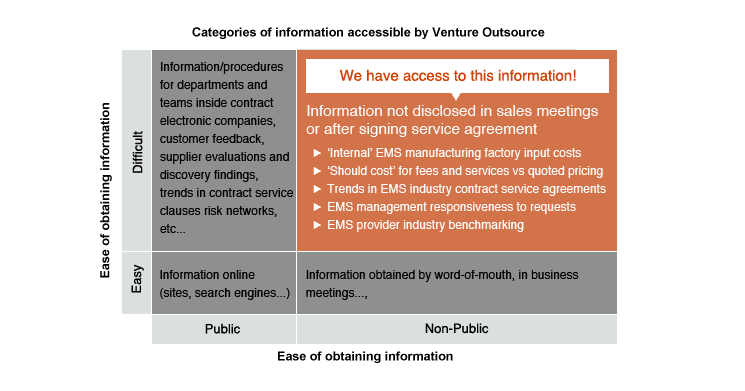
In talking with electronics OEM decision makers, providing knowledge and content that goes deep into OEM business circumstances and OEM risk-decisioning in various ways is helpful when OEMs are faced with gathering industry information and vetting and selecting EMS partners.
 Mark Zetter
OEM equipment buyers of EMS services, reading this can help you better understand the EMS manufacturing sales process to uncover provider motivations, pain points, and better pricing.
OEMs can also enhance EMS provider due diligence with more informed and accurate questions about EMS provider capabilities, capacity, and provider commitment to your program which can help you set more realistic expectations regarding EMS provider execution lead times, pricing, and service levels.
OEMs who comprehend the extent of the EMS provider sales process can also develop more strategic relationships with respective providers.
By understanding the EMS sales process, OEMs can better assess the financial health, operational stability, and long-term viability of their EMS providers allowing OEMs to mitigate risks, ensure business continuity, and maintain a more resilient supply chain.
For EMS manufacturers wanting to grow your business with new customers, you want ways to engage in dialogue with OEM prospects sooner - and on a deeper level.
EMS providers also want to mitigate many of the risks directly attributable to reasons above - why some of EMS providers are losing OEM deal opportunities during critical sales and business development phases.
I like writing and talking about the nuances of EMS manufacturing industry and supply chains. Reach out with questions here.